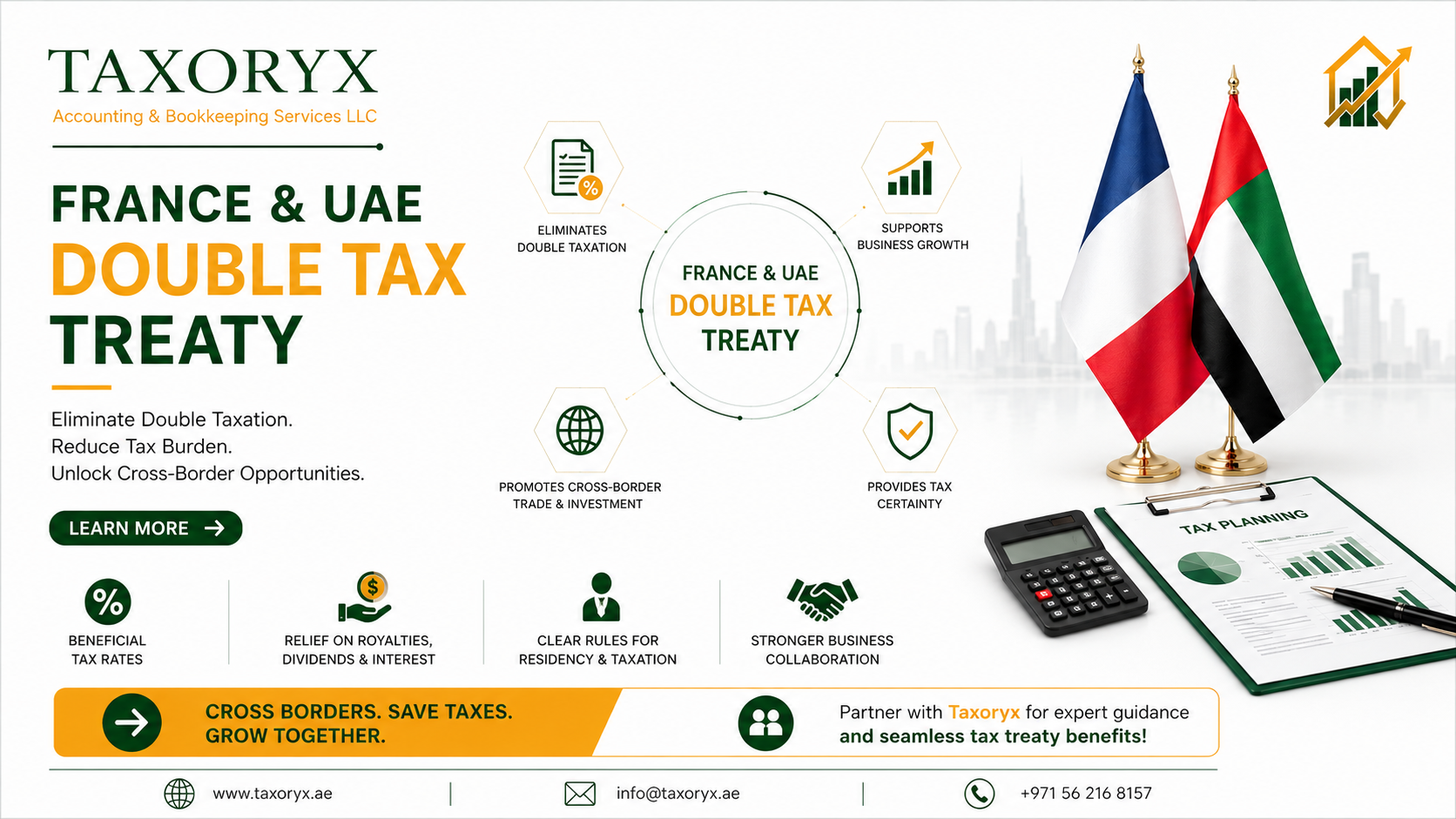
France-UAE Double Tax Treaty: Everything Businesses and Individuals Need to Know
Expanding business across borders opens up exciting opportunities—but it also raises important tax questions.
One of the most common concerns we hear at Taxoryx from businesses and professionals operating between France and the UAE is:
“Will I end up paying tax twice on the same income?”
The good news is that the France-UAE Double Taxation Avoidance Agreement (DTAA) was specifically designed to prevent this situation. Whether you’re a business owner, investor, consultant, or employee working across both countries, understanding how this treaty works can help you minimize tax exposure and remain compliant with both jurisdictions.
What Is the France-UAE Double Tax Treaty?
The France-UAE Double Tax Treaty is a bilateral agreement between France and the United Arab Emirates aimed at eliminating double taxation and promoting cross-border trade and investment.
In force since 1990, the treaty establishes clear rules regarding which country has the right to tax specific types of income. Its primary objective is simple:
To ensure that the same income is not taxed twice while providing certainty for businesses and individuals operating internationally.
For example, if a UAE-based consultant provides services to a French client from Dubai, the income may generally be taxable only in the UAE rather than in both countries.
However, the tax treatment can change depending on factors such as physical presence, business activities, and the location where services are performed.
Understanding the 183-Day Rule
One of the most important provisions under the treaty relates to physical presence.
If an individual performs services in France and remains there for more than 183 days within a twelve-month period, France may obtain taxing rights over that income, subject to the treaty’s specific conditions.
This is why businesses and professionals working across borders should carefully monitor travel days and maintain accurate records.
How Double Taxation Relief Works
The treaty prevents double taxation through two primary mechanisms:
1. Tax Credit Method
Under the tax credit method, income may be taxed in one country, while the other country provides a credit for taxes already paid.
For example, if a French tax resident earns income in the UAE and pays applicable taxes there, France may allow a credit for those taxes when calculating the individual’s French tax liability. This ensures the income is not taxed twice.
2. Tax Exemption Method
Under the exemption method, one country may exempt income that has already been taxed in the other country.
For instance, where treaty provisions grant France the primary taxing right over certain income earned by a UAE resident, the UAE may exempt that income from further taxation, eliminating the risk of double taxation.
Tax Treatment of Different Types of Income
Dividends, Interest, and Royalties
One of the major advantages of the France-UAE tax treaty is the favorable withholding tax treatment.
The treaty generally provides for a 0% withholding tax rate on dividends, interest, and royalty payments between France and the UAE, subject to meeting treaty conditions.
This can create substantial tax savings for investors, multinational groups, and businesses receiving cross-border payments.
However, treaty benefits are not applied automatically. Taxpayers must generally provide supporting documentation and establish their eligibility under the treaty.
Business Profits
Business profits are typically taxable in the country where the company has a Permanent Establishment (PE).
A Permanent Establishment generally refers to a fixed place of business, such as:
Branch offices
Corporate offices
Factories
Workshops
Warehouses
Long-term construction sites
If a UAE company operates in France through a Permanent Establishment, France may tax the profits attributable to that establishment.
Similarly, French businesses operating through a Permanent Establishment in the UAE may become subject to UAE tax rules.
The key factor is determining where the economic activity and business presence actually exist.
Employment Income
Employment income is generally taxed in the country where the work is physically performed.
For example:
Salary earned for work performed in the UAE is generally taxable under UAE rules.
Salary earned while physically working in France may become taxable in France.
The treaty’s 183-day rule and other employment provisions can influence the final tax treatment, making careful planning essential for expatriates and international employees.
Capital Gains
The taxation of capital gains depends on the type of asset being sold.
Generally:
Gains from real estate are taxed in the country where the property is located.
Gains from shares and other securities are often taxed in the country of residence of the seller, subject to treaty provisions.
Each transaction should be assessed individually to determine the applicable treaty treatment.
Who Can Benefit from the France-UAE Tax Treaty?
The treaty offers significant advantages to various categories of taxpayers, including:
Businesses and Companies
Companies conducting operations, trade, or investments between France and the UAE can reduce tax exposure and avoid double taxation through proper treaty planning.
Investors
Investors receiving dividends, interest, royalties, or capital gains may benefit from reduced withholding taxes and favorable tax treatment.
Employees and Expatriates
Professionals working between France and the UAE can use treaty provisions to avoid unnecessary taxation and clarify their tax obligations.
Entrepreneurs and Consultants
Business owners and independent professionals providing cross-border services can structure their activities efficiently and remain compliant with both tax systems.
Practical Checklist Before Doing Business Between France and the UAE
At Taxoryx, we recommend taking the following steps before entering into cross-border arrangements:
Obtain a Tax Residency Certificate
A UAE Tax Residency Certificate (TRC) is often required to claim treaty benefits and demonstrate UAE tax residency.
Clearly Define Service Locations
Contracts should clearly specify where services are performed and where value is created.
For example, consultants delivering services from the UAE should ensure their agreements accurately reflect this arrangement.
Monitor Physical Presence
Track travel days carefully, particularly when working in France, as exceeding the 183-day threshold could create additional tax obligations.
Maintain Proper Documentation
Keep complete records of:
Contracts
Invoices
Tax residency certificates
Travel records
Financial statements
Supporting tax documentation
Proper documentation is often the deciding factor when claiming treaty benefits.
Seek Professional Advice
Cross-border taxation can be complex. Obtaining guidance from qualified tax professionals in both jurisdictions can help avoid costly mistakes and ensure compliance.
Why the France-UAE Tax Treaty Matters
The France-UAE Double Tax Treaty is more than just a legal agreement—it is a valuable tool for businesses, investors, and professionals looking to operate internationally with confidence.
When properly applied, the treaty can help:
Avoid double taxation
Reduce withholding taxes
Improve tax efficiency
Facilitate international business expansion
Enhance compliance and reduce tax risks
Understanding where income is earned, where work is performed, and where value is created is essential to maximizing treaty benefits.
How Taxoryx Can Help
At Taxoryx, we help businesses, investors, and individuals navigate the complexities of international taxation and double tax treaties.
Our tax specialists can assist with:
France-UAE Double Tax Treaty analysis
Tax Residency Certificate applications
Cross-border tax planning
Corporate tax advisory
International tax compliance
Permanent Establishment assessments
Transfer pricing advisory
Tax documentation and reporting support
Whether you’re expanding into France, investing in the UAE, or managing operations across both countries, Taxoryx provides practical and tailored tax solutions designed to minimize risks and maximize available treaty benefits.
Need expert guidance on France-UAE taxation? Contact Taxoryx today and let our international tax specialists help you structure your business efficiently while staying fully compliant.